
As featured in ‘Times Education Guide’ on Saturday, 28th March 2026
“At The Green Acres Academy, a laptop is not a privilege or distraction. It is a learning tool. And knowing how to use it purposefully is as fundamental as knowing how to read.
Today’s workplaces run on personal computers. Across professions, digital tools are being used to research and verify, to design and animate, to code and compute, to collaborate, and to create. And yet, schools continue to focus on rote learning, leaving students unequipped for the workforce on graduation. The only classrooms truly shaping the future of children are those that develop the ability to navigate digital tools, think critically, collaborate effectively, and create with confidence.
At a glance: The TGAA model
- One student, one laptop, introduced from Grade 2
- Progressive induction: responsibility and digital habits before complexity
- Multimodal learning: simulations, animations, games, and interactive tools
- CFU quizzes after every lesson, real-time data for every teacher
- Created-curated content connecting curriculum to the real world
- Digital literacy: source evaluation, cyber safety, and responsible use
- Future-ready skills: coding, design, presentations, and productivity tools
The Green Acres Academy: Mumbai’s First Google Reference School
For outstanding use of technology to drive positive learning outcomes, The Green Acres Academy has been recognised as the first Google Reference School in Mumbai. This approach is also fully aligned with NEP 2020’s vision of technology integration in teaching and learning, the National Curriculum Framework’s emphasis on experiential, competency-based education, and the ICSE framework’s commitment to strong academic grounding. Innovation at TGAA does not come at the cost of academic rigour.
Starting right
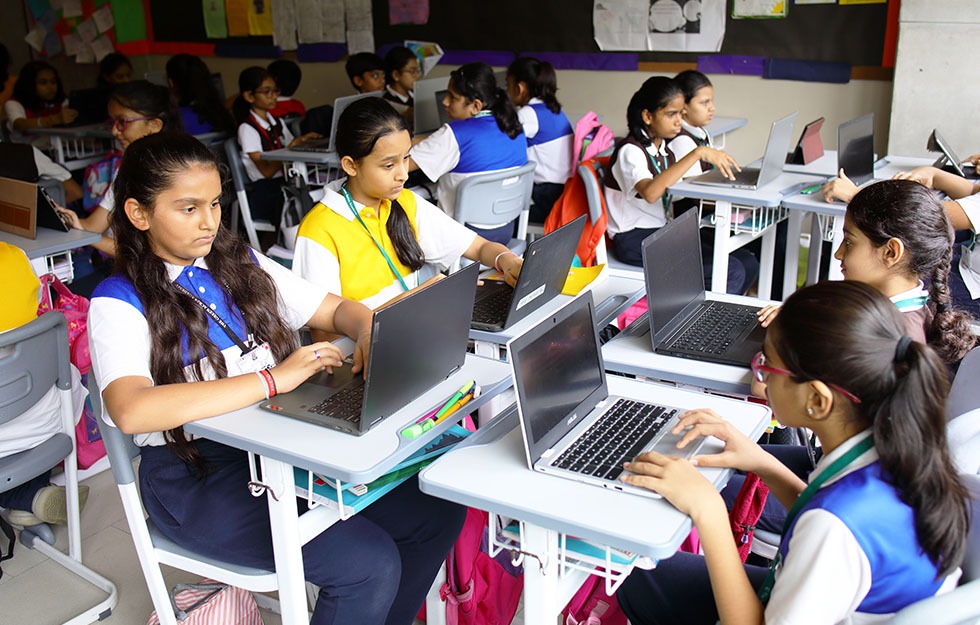
Students are required to have a personal laptop for use in class from Grade 2. The goal is familiarity first, complexity later, with a focus on responsibility. They learn how to handle their device carefully, how to protect their eyes, wrists, and posture through yoga exercises, and even when to use headphones. They learn the importance of balancing screen time with outdoor play. Good digital habits are built early, before poor ones have a chance to form.
Learning with laptops
Across academic use, the application of technology is purposeful. Games explain complex concepts and improve retention. Multimodal learning experiences combining text, visuals, animations, simulations, and interactive tools make ideas accessible in ways traditional could not. Content at TGAA also follows a created-curated model: internally designed curriculum materials are paired with high-quality content from credible external sources, helping students understand the relevance of what they are learning. For example, instead of trying to grasp the concept of weather systems only from a static graph or image, students can now interact with a model and see real-world examples to deepen their understanding and retention.
Digital citizenship and future-ready skills
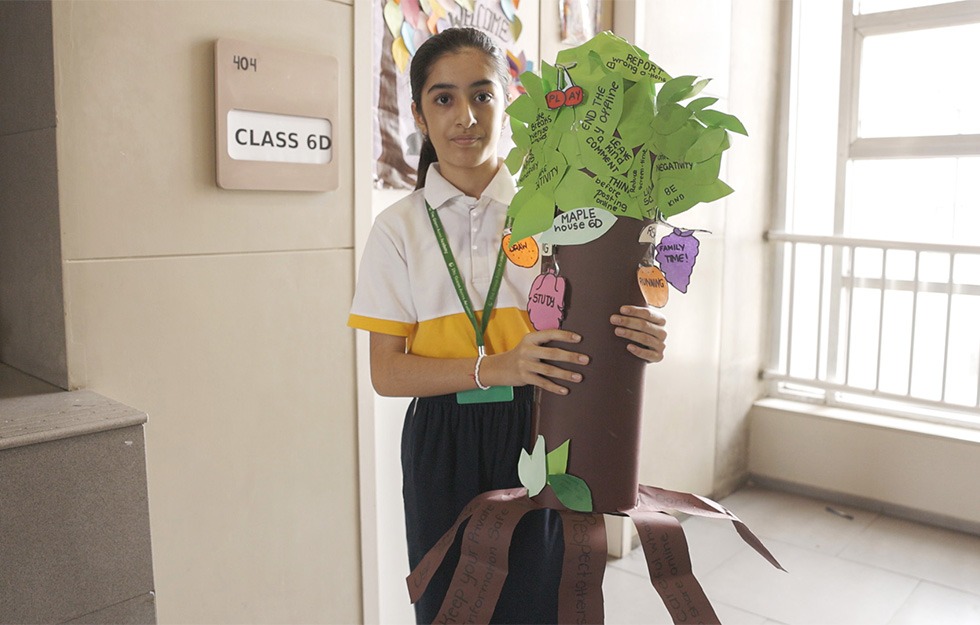
Learning how to use a laptop well implies both, purposeful and responsible use. When students graduate into a world of unrestricted access, the habits they carry will determine how they use technology in every setting. Building responsible use is not a separate programme; it is woven into how every lesson at TGAA is taught.
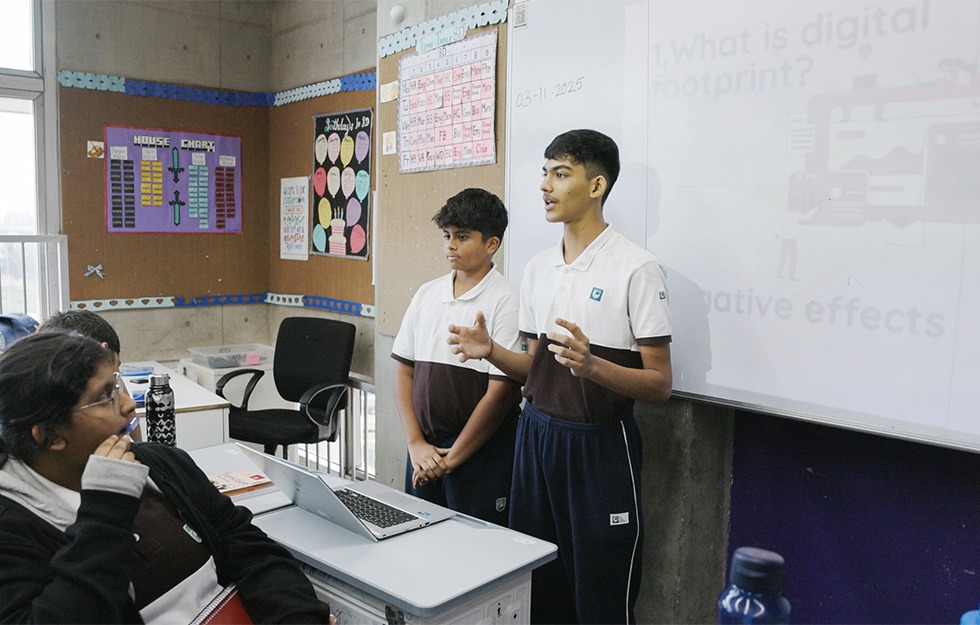
In a world full of misinformation and AI-generated content, knowing how to find and evaluate credible sources is a core skill. TGAA teaches safe browsing, source evaluation, and responsible digital behaviour. Initiatives like the Cyber Safety Week bring structured learning on online safety, cyber bullying, digital identity protection, and data security to all grades.
Structured, not saturated
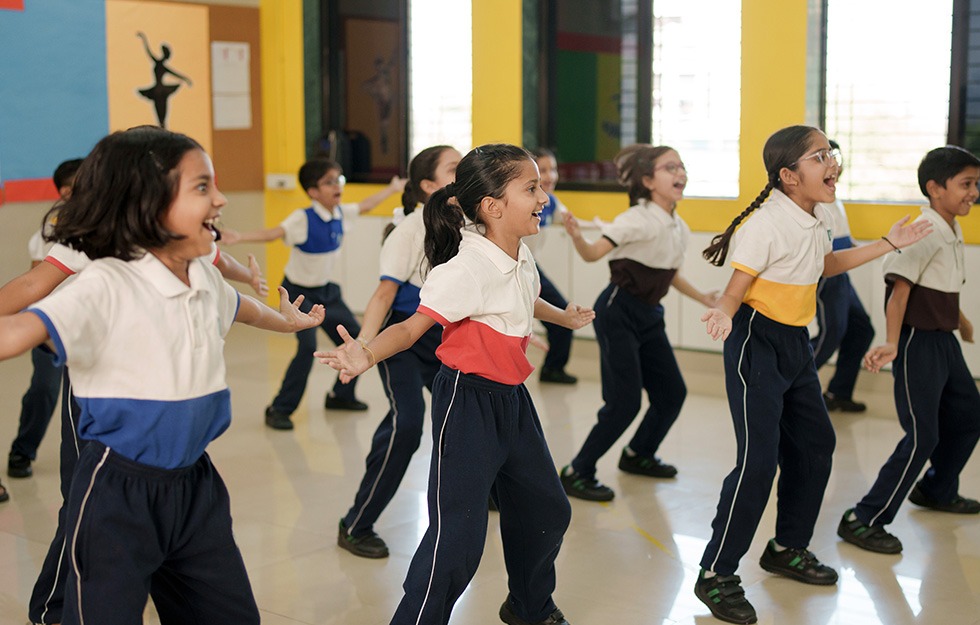
A structured observation of classroom sessions across multiple grades at TGAA’s campuses found that laptops account for under 20% of the school day. Devices are one tool within a broader system, used only where they add value. The dominant mode of learning remains relational: between teacher and student, peers, idea and inquiry. Laptop use does not come at the cost of other essential experiences; every TGAA student’s day is intentionally structured to include physical movement, sport, music, dance, creative expression, and sustained peer interaction, with dedicated space for cognitive, physical, and creative development. Laptops never compete with this structure; they seamlessly fit into it.

Learning with Personal Devices Changes Everything
The way children learn has not changed. But the tools available to support that learning have.
Children learn better in the right conditions
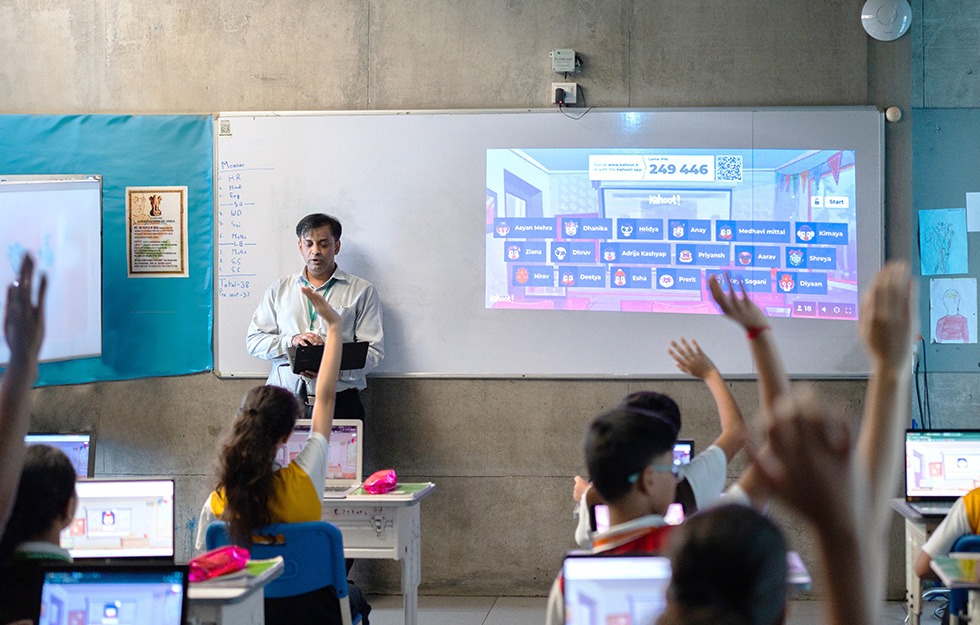
The idea of continuously checking for understanding has been advocated in Indian educational thinking since the 1960s. In a conventional setting, teachers administer tests at the end of a unit, take them home to grade, and by then the class has already moved on. With spontaneous, end-of-lesson Checks For Understanding, a teacher can identify gaps the same day and revisit the concept the very next morning, before it compounds. Technology makes this possible at scale. A short quiz delivered to each student on their own laptop gives a teacher immediate data on every child in the room. TGAA has built this into every single lesson, across every grade.
The future belongs to creators, not just consumers
The children in today’s classrooms will enter a world where the ability to communicate, collaborate, and create using technology is assumed from day one, across virtually every professional field. Schools that treat digital skills as optional extras are asking children to compete in a world they have never been properly introduced to. The question for every school is whether it is lifting children toward that world, or leaving them to figure it out on their own, years too late.
The tools of work have changed, permanently
The modern world no longer forgives the use of outdated tools to complete tasks; you cannot code or animate on paper and transfer later. Sustained practice with the actual tools the world uses is essential for the future workforce. The OECD Learning Compass 2030 makes this plain: if education does not rise to meet technology and integrate it meaningfully, children face increased disadvantage. When technology and learning are effectively integrated, students are presented with greater opportunities, and, most importantly, a fluency in the language of the 21st century.
When laptops earn their place
Laptops are best used when they enhance understanding, when they enable feedback, and when they make learning more genuinely engaging. The balance between workbooks, handwriting, and device-based work must be maintained deliberately. The aim is not to replace what works; it is to add what was previously impossible.
TGAA’s approach is built on a clear principle: one child, one laptop, and every minute of laptop time is deliberate. No child falls through the cracks; each student in a class of 40 has the same access, the same ability to engage, and the same opportunities to be assessed and supported individually. And not a single moment of screen time is left to chance.
Good screen time, bad screen time
The argument for personal devices in classrooms is only as strong as the school’s ability to ensure that the time spent on them is genuinely worthwhile. This is where TGAA’s approach stands out in comparison to other schools.
Most public debates on screen time address the wrong issue. The question is not how much. It is what kind. A systematic 2023 review of screen-time literature by Zahedi et al. for the ACRES Foundation found that the measurable harm associated with screen time is, in most studies, too small to justify sweeping restrictions on educational screen use. More importantly, those studies almost universally fail to distinguish between passive consumption, like scrolling, watching, and drifting, and active, purposeful engagement such as a child building a presentation, debugging code, or using a simulation to understand how a cell divides. These are categorically different experiences. Treating them as the same distorts both the evidence and the decisions parents and schools make based on them.
The research is also clear on where real concern lies. Screen use becomes problematic when it displaces physical activity, sleep, or meaningful social interaction. At TGAA, those things are protected by design. Laptops account for restricted hours of the school day. The rest is movement, creativity, conversation, and inquiry. A school that protects these things by design is not contributing to a screen-time problem; it is solving one.
The idea that harmful screentime can be eliminated from modern life is a fallacy – the goal parents need to focus on is developing the tools to minimise passive consumption, and encourage purpose-driven use. And that’s where TGAA’s approach becomes essential.
Learn more about TGAA’s future-ready outlook on education: www.tgaa.in